Searching for 50 miles to km confirms that this distance is equal to 80.4672 kilometers. This conversion relies on a fixed mathematical relationship where one mile is defined as exactly 1.609344 kilometers. Whether you are planning a trip, studying physics, or simply need to understand road signs in different countries, knowing how to convert these units accurately is a useful skill.
ConvertersNovember 4, 2026
50 Miles to Kilometers: 80.4672 km Conversion Guide
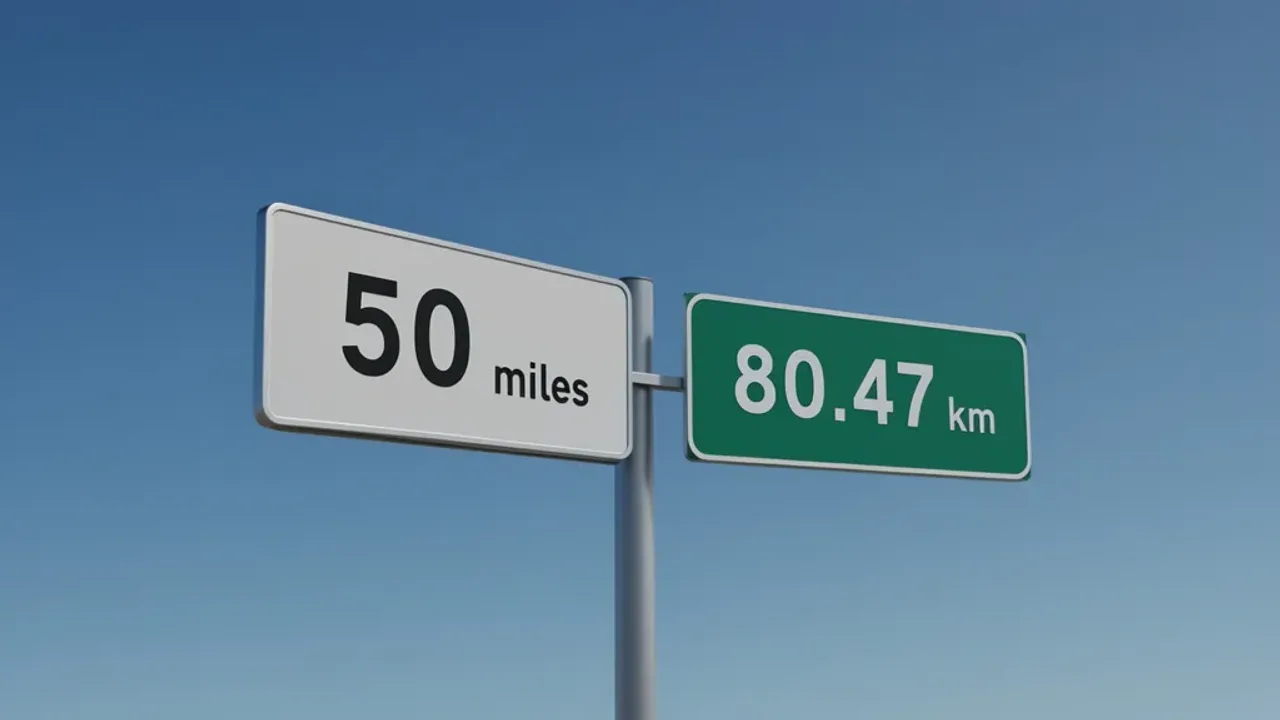 AI-generated image
Key Takeaways:
- 50 miles converts precisely to 80.4672 kilometers.
- The conversion constant for any distance in miles is 1.609344.
- Using the exact multiplier ensures accuracy for technical and scientific measurements.
- Nautical miles operate on a different scale and should not be confused with standard land miles.
Conversion Methodology
To perform the conversion, multiply the total distance in miles by the constant 1.609344. This specific number comes from the international standard that defines a single mile as exactly 1,609.344 meters. Because a kilometer represents 1,000 meters, dividing the meter value by 1,000 shifts the decimal point, resulting in the standard kilometer factor used today.
Understanding the mechanics behind 50 miles to km helps in applying the logic to any other distance measurement. It is straightforward. When working with these units, keep these items in mind:
- Always verify if the distance is in standard land miles or nautical miles.
- Use the full decimal value for high-precision engineering or scientific requirements.
- Double-check your calculations when dealing with long-distance travel planning.
- Keep a calculator handy for quick, accurate results during your tasks.
Distance Comparisons
| Distance in Miles | Distance in Kilometers |
|---|---|
| 10 miles | 16.09344 km |
| 25 miles | 40.2336 km |
| 50 miles | 80.4672 km |
| 75 miles | 120.7008 km |
| 100 miles | 160.9344 km |
Practical Implementation
Applying this formula is necessary for navigation between regions using different systems. Follow these steps for consistency:
- Identify the total distance in miles.
- Apply the 1.609344 multiplier to the total.
- Round the final result only if the application allows for a margin of error.
Accuracy matters. Precision is key in every measurement.
Frequently Asked Questions
How is the 1.609344 factor defined?
This factor is based on the international agreement establishing one mile as exactly 1,609.344 meters. Since a kilometer consists of 1,000 meters, the conversion factor is the meter count divided by 1,000.
Is 50 miles the same as 50 nautical miles?
No. A nautical mile is a distinct unit used primarily in maritime and aviation contexts. One nautical mile equals 1.852 kilometers, which is longer than a standard land mile.
Can I round the conversion factor to 1.6?
Rounding to 1.6 is acceptable for casual estimates or mental math. However, for engineering or scientific work, you must use the full 1.609344 value to avoid cumulative errors.
Why do different countries use different units?
The use of miles versus kilometers stems from historical measurement standards adopted by various governments. While the metric system is global, some regions maintain the imperial system for road distance and speed.
Does speed affect the distance conversion?
No. The conversion between miles and kilometers is a purely geometric relationship between two units of length. It remains constant regardless of how fast you are traveling.
Summary
Converting 50 miles to km results in 80.4672 kilometers when using the standard multiplier of 1.609344. Always utilize this exact factor for technical tasks to maintain the highest level of precision.
Share: