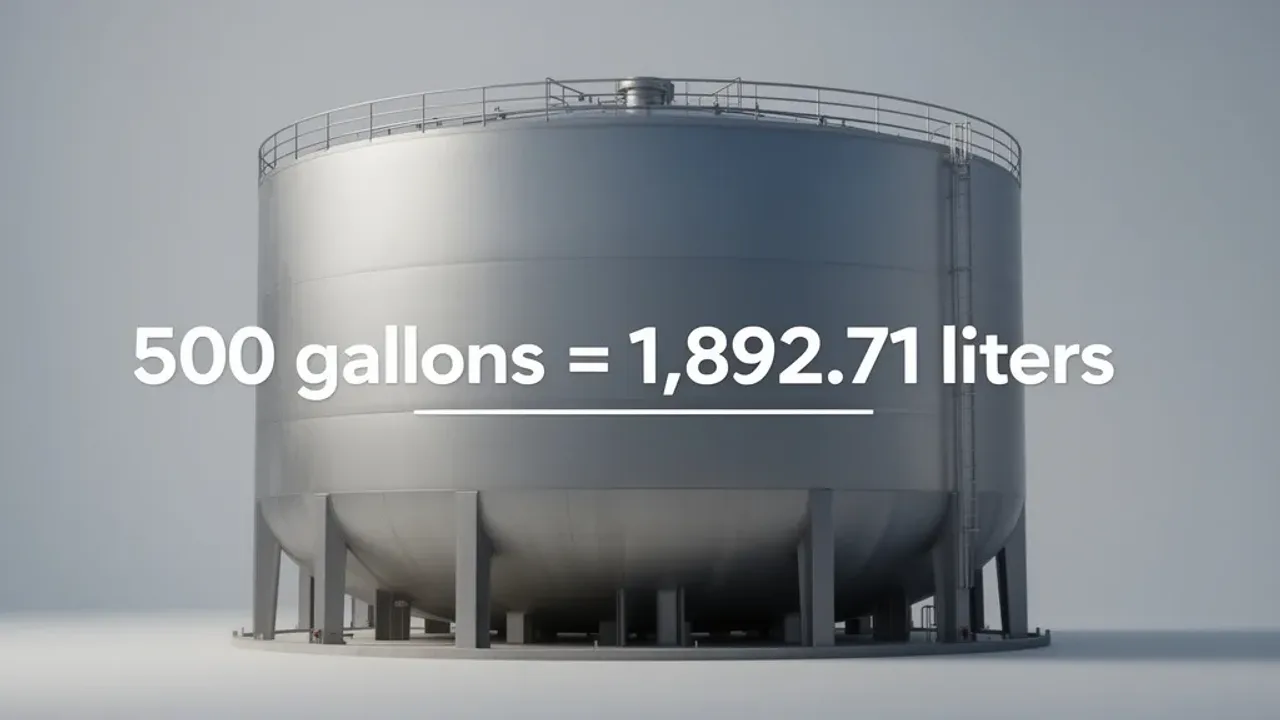
The conversion of 500 gallons to liters yields exactly 1,892.71 liters. This calculation is derived from the standard US liquid gallon, which is defined by international agreement as exactly 3.785411784 liters. Understanding this relationship is critical for anyone managing liquid volumes in industrial, commercial, or residential settings. It is a precise standard. Use it carefully to avoid errors.
ConvertersOctober 16, 2026
500 Gallons to Liters: Conversion to 1,892.71 Liters
 AI-generated image
Key Takeaways:
- The standard result for 500 gallons to liters is 1,892.71 liters.
- One US liquid gallon equals 3.785411784 liters.
- Always distinguish between US liquid gallons and imperial gallons.
- Using the full conversion factor prevents rounding errors in large-scale tasks.
Conversion Calculation Explained
To convert US liquid volume measurements effectively, one must apply the standard conversion factor. When you calculate 500 gallons to liters, you multiply the volume by 3.785411784. This mathematical constant ensures that the resulting volume in liters maintains international consistency across all applications. It works every time.
When performing these conversions, consider the following steps to maintain precision and reliability in your data:
- Confirm the specific unit system in use, as US and imperial gallons differ significantly.
- Use the full conversion factor of 3.785411784 rather than rounded figures for large volumes.
- Verify the final result against the intended application, such as tank capacity or fuel storage.
| US Gallons | Liters |
|---|---|
| 100 gallons | 378.54 liters |
| 250 gallons | 946.35 liters |
| 500 gallons | 1,892.71 liters |
| 750 gallons | 2,839.06 liters |
| 1,000 gallons | 3,785.41 liters |
Practical Applications
Accurate conversion is essential when managing large-capacity storage tanks, such as those used for residential water systems or fuel storage. Precise volume conversion ensures that equipment specifications and safety requirements are met during the filling or maintenance of these containers. Safety remains paramount. Equipment must match specifications.
Consider these points during tank management:
- Inspect storage tank integrity for leaks before filling to capacity.
- Ensure the containment area is rated for the total volume in liters.
- Consult manufacturer specifications for tank volume limits.
- Document all volume changes to maintain accurate inventory records.
- Calibrate monitoring sensors based on the correct unit of measure.
Frequently Asked Questions
Is the conversion the same for imperial gallons?
No, the conversion differs because the imperial gallon is a distinct unit of measurement. An imperial gallon is approximately 4.54609 liters, meaning 500 imperial gallons would result in a higher total than 500 US liquid gallons. Do not mix them.
Why do conversion results sometimes differ slightly?
Variations in results occur due to the level of rounding applied to the conversion factor of 3.785411784. Using a more precise factor provides a more accurate result, while simpler versions are often used for quick estimations. Use the full number for accuracy.
Are there different types of US gallons?
The standard US liquid gallon is the most common unit used for general volume measurements. While there are other definitions for dry gallons, the standard liquid gallon is the default for most consumer and industrial applications. Stick to liquid measurements.
How can I calculate other volumes quickly?
You can multiply any number of US gallons by 3.7854 to get a reliable result in liters. For high-precision requirements, continue using the full 3.785411784 factor. Keep it simple.
Does temperature affect the conversion?
The mathematical constant remains fixed and does not change based on temperature. However, the physical volume of a liquid may expand or contract with heat, which is a factor to consider in industrial storage. Factor this in.
To convert 500 gallons to liters accurately, multiply the volume by the factor of 3.785411784. Always verify whether the volume measurement refers to US liquid gallons or imperial gallons to maintain calculation precision.
Share: