The correct spelling is separate, while seperate is an incorrect spelling of the word. You should always use the "a" after the "p" to ensure your writing is accurate. Deciding between seperate or separate is a common challenge that every writer faces when aiming for precision and clarity in their professional and academic work.
SpellingAugust 23, 2026
Separate: The Correct Spelling Explained
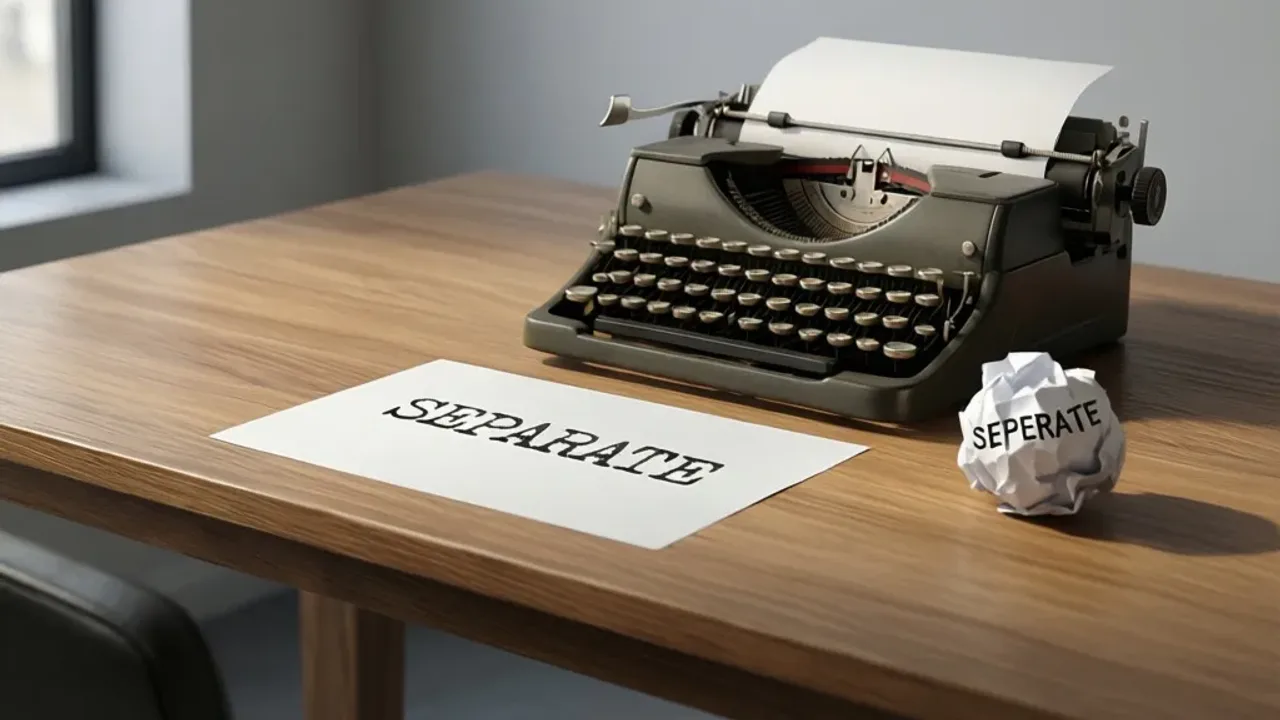 AI-generated image
Key Takeaways:
- The only correct spelling is separate, which uses an "a" after the "p."
- The term seperate is a common misspelling that should never be used.
- You can remember the correct form by noting that the word contains "a rat" in the middle.
- Correct orthography is essential for maintaining professional standards in all documentation.
| Feature | Separate | Seperate |
|---|---|---|
| Correctness | Standard English | Incorrect |
| Formal Usage | Required | Prohibited |
| Dictionary Status | Recognized | Non-existent |
| Recommendation | Use this spelling | Avoid this spelling |
When to Use Which
You should always choose the spelling separate whenever you need to describe things that are set apart or not joined together. This version is the standard recognized by dictionaries and is required for all forms of academic, professional, and casual communication. There is no context or situation where the spelling seperate is considered acceptable or correct. It is wrong. If you find yourself typing an "e" after the "p," you should immediately correct it to an "a" to ensure your spelling remains accurate. Maintaining this standard is a fundamental part of effective communication.
When you are drafting an email, a report, or a formal essay, precision matters. Readers notice errors. Using the correct spelling helps establish credibility. It shows that you value accuracy in your work. If you have been using the incorrect form, now is the time to adjust your habits. You can easily train yourself to spot the error before you hit send. Just take a moment to review your writing. It pays off.
Why the Confusion Is So Common
The misspelling occurs primarily because of the way the word is pronounced in casual speech. When many people speak English, the middle syllable of the word is often reduced or obscured, making it sound more like "sep-rit" rather than "sep-uh-rate." This phonetic ambiguity leads individuals to guess the spelling based on the sound they perceive, often substituting the "a" with an "e." Because the middle vowel is unstressed, the written form is frequently confused by those who rely on phonetics rather than standard orthographic rules. When considering seperate or separate in your daily writing, remember that standard orthography must always override phonetic approximation.
In addition to phonetic influence, the prevalence of this error is amplified by digital communication. Many people write quickly and do not proofread. Once an error is typed repeatedly, it can become a habit. However, you can break this cycle by being mindful of the specific letter placement. Focus on the "a." It is the key to getting it right every time.
Strategies for Correct Spelling
To avoid common mistakes, you can implement a few practical strategies. These methods will help reinforce the correct spelling in your memory:
- Check your documents specifically for the "a" after the "p."
- Use spell-check tools to identify common errors automatically.
- Practice writing the word correctly on paper to build physical muscle memory.
- Create a visual reminder on your workstation if you find yourself struggling.
Following a systematic approach to editing is also highly effective. Consider these steps:
- Identify the root word to confirm the proper structure.
- Prioritize standard dictionary forms over quick, phonetic guesses.
- Edit your work to correct the common error of using an "e."
- Review your final draft with a focus on spelling consistency.
Frequently Asked Questions
Is "seperate" ever considered an acceptable alternative spelling?
No. It is strictly classified as a misspelling by all recognized English dictionaries. Do not use it in any context, whether formal or informal.
What is an easy way to remember the correct spelling?
A common mnemonic is to remember that there is "a rat" in the middle of "sep-a-rat-e." Associating the spelling with this word can help you ensure that the letter "a" is placed correctly after the "p."
Does the spelling change depending on the part of speech?
No. The spelling remains the same regardless of whether the word is used as an adjective, a verb, or a noun. The correct form is always spelled with an "a" after the "p."
Why is "seperate" so often misused?
The error stems from the unstressed vowel in the middle of the word, which makes the pronunciation sound ambiguous. Many people inadvertently write the word exactly as it sounds to them in casual conversation. It is a very common oversight.
Are there any regional variations for this word?
No. The spelling of separate is consistent across all major varieties of English, including American and British standards. You should use the same spelling regardless of your location.
The only correct way to write this word is separate, as the version with an "e" is a persistent misspelling. Always prioritize the dictionary-approved spelling to ensure your written communication remains professional and accurate.
Share: